Lily Maxwell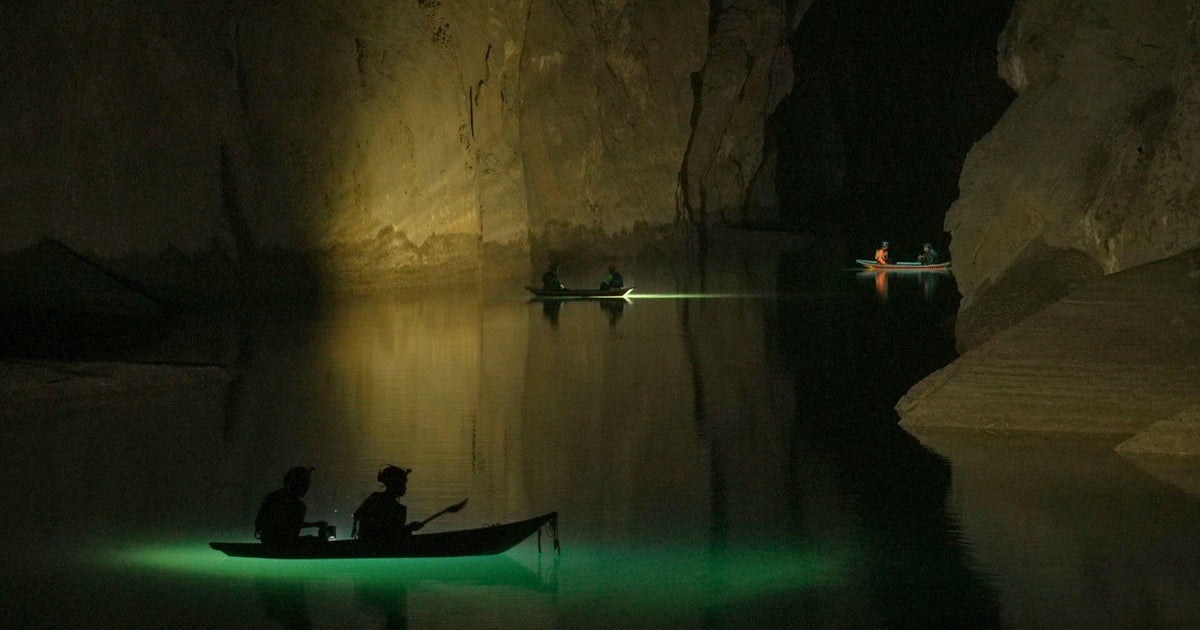
Vietnam’s Son Doong is big enough to fit a skyscraper, but despite its immense size, it took 18 years for Ho Khanh, the man who first found the entrance, to rediscover Hang Son Doong, deep inside a Vietnamese jungle.
In 2009, Peter MacNab, along with a five-man team, were the first to explore the cave after Ho Khanh’s discovery. They descended into darkness, with no idea what lay inside the depths of Son Doong.
“Every corner you went round was completely new, completely exciting,” MacNab said. “And it just kept getting better and better as you went into the cave. It was absolutely spectacular.”
Trekking through the jungle to Son Doong
MacNab recently returned to the cave with 60 Minutes correspondent Scott Pelley. The only way to get to Son Doong is on foot. There was a group of 53, mostly porters carrying camping equipment and TV gear, and experts in safety and climbing. Visitors need to splash through 20 river crossings en route to the cave.
The jungle, in the Truong Son range between Laos and the South China Sea, is home to tigers and leeches.
The entrance to Son Doong is hard to find. Ho Khanh was collecting wood when he first found it in 1990 while sheltering from a storm. He remembers feeling something strange: wind blowing out of the ground.
60 Minutes 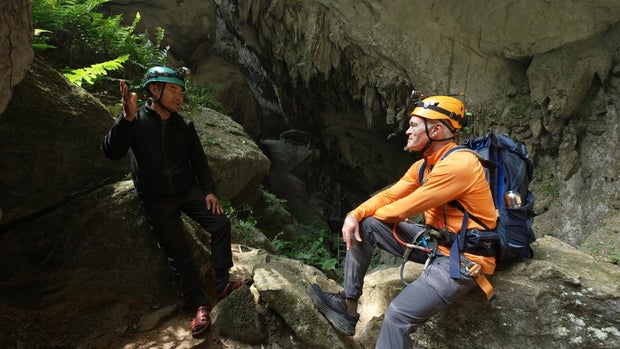
Cavers recognized that as a sign of a massive cavern, so in 2000, British cavers asked Ho Khanh to find the cave again. In 2008, eight years later, he located the entrance again. Exploration of the cave began in 2009. Today, there’s writing on the wall outside, proclaiming the miracle of Ho Khanh.
World’s largest cave passage started with a crack the width of a strand of hair
Visitors descend down a 30-story wall into darkness as they enter the cave. At the bottom is the Rao Thuong River. Its water is acidic, so it’s good at dissolving limestone, enabling the creation of the cave.
The formation of the cave started around 2.5 million years ago, Purdue University geologist Darryl Granger, who first came to Son Doong in 2010, said. It’s believed the river found a tiny crack,”the width of a hair,” in the limestone ridge.
“That’s all it takes to make a cave. The water started flowing through it and dissolving it bigger, and bigger, and bigger,” Granger said. “We still have water going through it, today. So, it’s continuing to get bigger, as we speak.”
60 Minutes 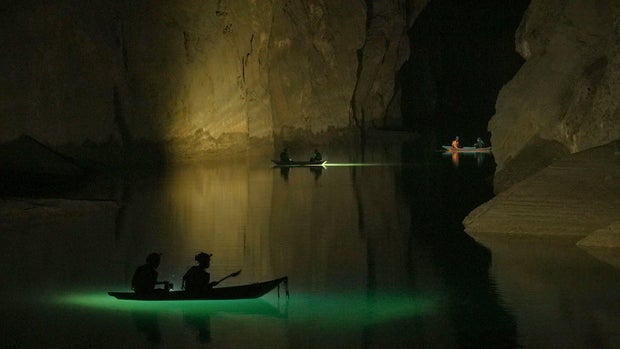
Water flows through the cave throughout the year. In the dry season, people can pass through. During the four months of wet season in fall and winter, visiting is impossible.
“In flood, the water’s over our heads,” Granger said. “We get 300 feet of water in this cave. And it’s not just, like, a bathtub; this is a raging river. And that water is able to dissolve the limestone and carry it out of the cave.”
Three days in Son Doong
Granger also joined 60 Minutes, along with cave explorer Howard Limbert, who over a period of decades, discovered around 500 caves in Vietnam. Limbert described the trek through Son Doong as “the best adventure that happens in the world.”
“That’s the beauty of caves,” Limbert said. “If you’re climbing a mountain, you can see where you’re going, but in a cave, when you go in, you don’t know what it’s going to do.”
60 Minutes’ journey through Son Doong took three days and two nights. It’s 5.6 miles long and, in places, 65 stories tall. The Great Pyramid of Giza would fit inside easily. A 747 plane could fly through the biggest passage and not scrape a wing, while in other areas, the only way forward was through tight passages.
There’s no cellphone reception in the cave, leaving visitors cut off from the world.
Roughly halfway through the cave is the first of two dolines, skylights where the roof collapsed. They’re a break from the total darkness. As the cave grew over millions of years, the limestone at the top was unable to support the roof above, creating a break in the ceiling. With sunlight streaming through the doline, the jungle entered the cave.
60 Minutes 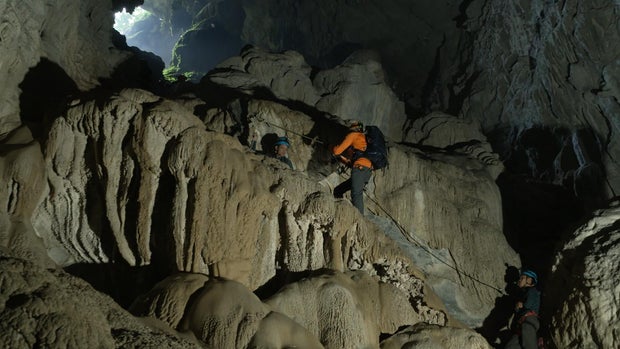
Continuing on, there’s an underground lake, then a steep, 30-story wall, called “The Great Wall of Vietnam.” MacNab ran out of time on his first visit to the cave, so he didn’t reach the end during his first expedition.
It’s a 300-foot climb on slick rock with no footholds anywhere.
“It’s challenging enough until you realize, of course, you are doing it in the dark and it’s, essentially raining. The ground water is coming from the roof,” Pelley said.
MacNab said he returns to Son Doong every two years.
“And we’ve barely scratched the surface of the caves in this area,” he said.
But there is a deadline. The marvel of Son Doong will not last, though the ultimate end won’t come for a few million years. Erosion will win in the end, and the roof will collapse.
The world’s largest cave will, one day, become a canyon.