Lily Maxwell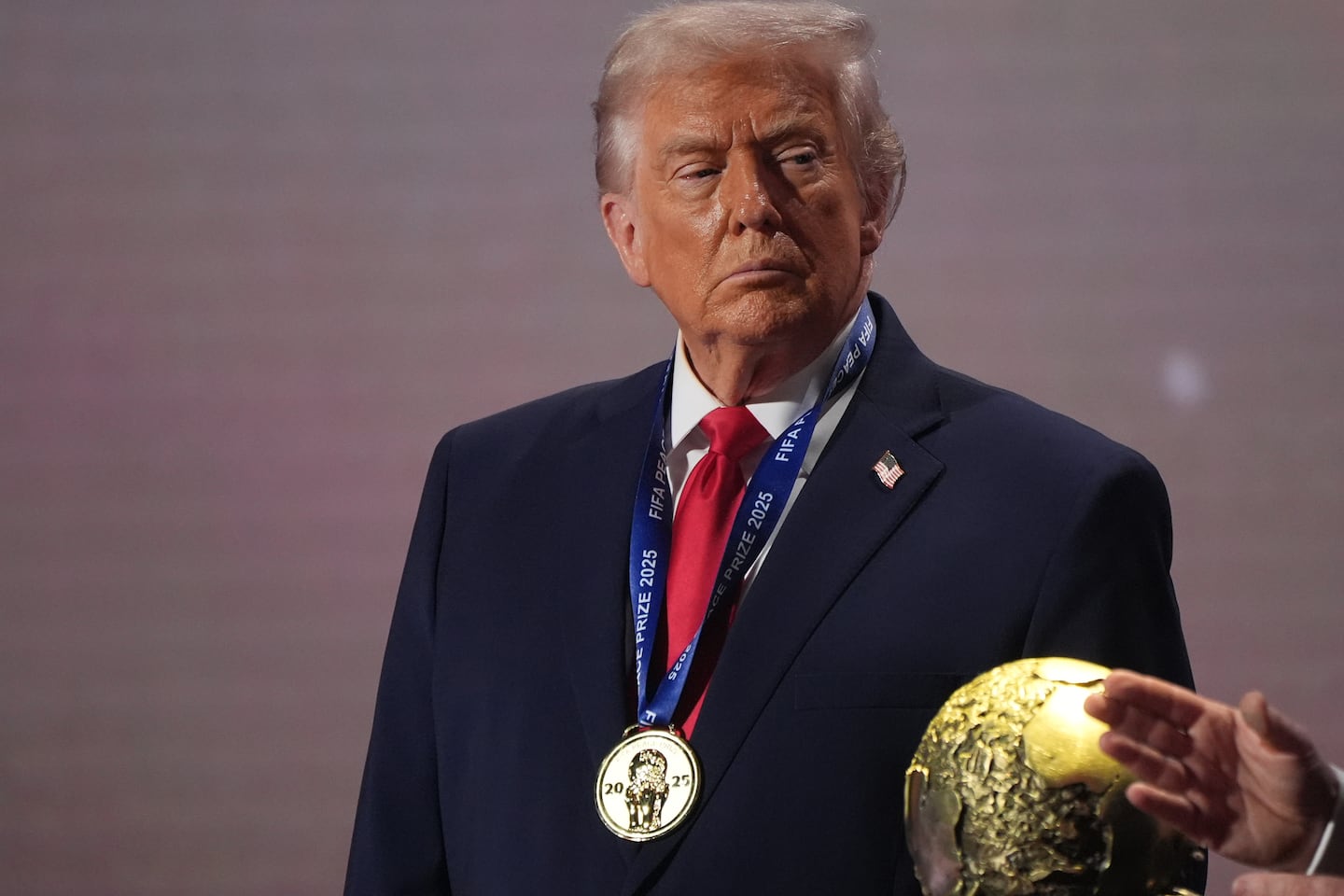
While many nonprofit groups bestow an honor on someone with the hope of getting that person to the dinner and then selling tickets for people to see that person at a fund-raiser, that is not at all why this occurred. It is basically a given for decades now that a sitting president will speak at the large annual gala to help raise money for their party’s congressional campaign committees. No one needed to lure Joe Biden or George W. Bush to these gatherings with an award. Every president has a vested interest in helping their party get as many seats in Congress as possible.
Trump has attended the very same event before and didn’t need some made-up award.
But giving Trump an award is now such a pattern that it has evolved into something more performative.
In Trump’s first term, the honors looked like the kind presidents have long received. On his first overseas trip in 2017, he was awarded Saudi Arabia’s highest civilian decoration by King Salman, a standard diplomatic gesture meant to signal alignment and respect. That same year, a pro-Israel organization presented him with the Friends of Zion Award, recognizing his decision to move the US Embassy to Jerusalem.
Even late into his presidency, the pattern held. In 2020, Kosovo awarded Trump its Order of Freedom for his role in brokering a normalization agreement with Serbia. These were traditional honors: rooted in foreign policy, conferred by governments or established institutions, and tied — at least nominally — to specific actions.
But the shift came after Trump lost reelection, when the awards stopped being inherited and started being created.
Indeed, the origin story for this latest genre was probably in April 2021, when Florida Senator Rick Scott, then chair of the National Republican Senatorial Committee, presented Trump with a newly minted “Champion for Freedom Award.” This was not an existing honor with a lineage or a list of past recipients.
The timing was not incidental. Just months after the Jan. 6 attack on the Capitol, Republicans were navigating how closely to align themselves with Trump heading into the midterms. Scott’s decision to create and present the award was less about commemorating a discrete achievement than about signaling where he, and by extension the party’s campaign apparatus, stood.
From there, the model proliferated.
By Trump’s second term, the awards began to fall into two distinct categories. There were still traditional state honors, but they arrived in a different context. The United Arab Emirates awarded him the Order of Zayed. Egypt followed with the Order of the Nile. South Korea conferred its highest decoration, the Grand Order of Mugunghwa. These were, again, real, longstanding honors, but they landed in a political environment already primed for something more personalized.
Alongside them came a newer genre.

After Trump was not awarded the Nobel Peace Prize that he appeared to be gunning for, FIFA, the world soccer organization that puts on the World Cup, created an inaugural “FIFA Peace Prize” and gave the first one to Trump. An industry group declared him the “Undisputed Champion of Beautiful Clean Coal.” Even corporate leaders contributed, offering one-of-a-kind commemorative gifts that blurred the line between tribute and award. How else can one describe what Apple gave Trump, a statue made of 24 karat gold and glass?
Then there is another category: people giving legit awards to Trump he didn’t earn, but he gets to keep.
An Olympic athlete presented him with her Order of Ikkos medal. And, of course, a Venezuelan opposition leader symbolically handed him her Nobel medal, granted that was in the hope Trump would install her as leader of her country.
Presidents, of course, get all kinds of awards as a sign of respect to both the leader and the nation. But what’s different this time is that it is so transactional in nature and largely just unnecessary except for the fact they appear to mean a lot to Trump.
And that brings the story back to Johnson’s statue.
The “America First Award” is not simply another entry on the list. It’s the perfect version of the trend itself: an award created in real time, bestowed immediately, and framed as both honor and message.
In that sense, these awards are doing political work. They create visual moments for donors and supporters. They shape narratives about accomplishment and stature. And perhaps most importantly, they fill a gap: When traditional institutions do not provide a certain kind of validation, allies, or those who want to be an ally, can simply manufacture one.
And Trump loves them all the same.
James Pindell is a Globe political reporter who reports and analyzes American politics, especially in New England.