Jade Carter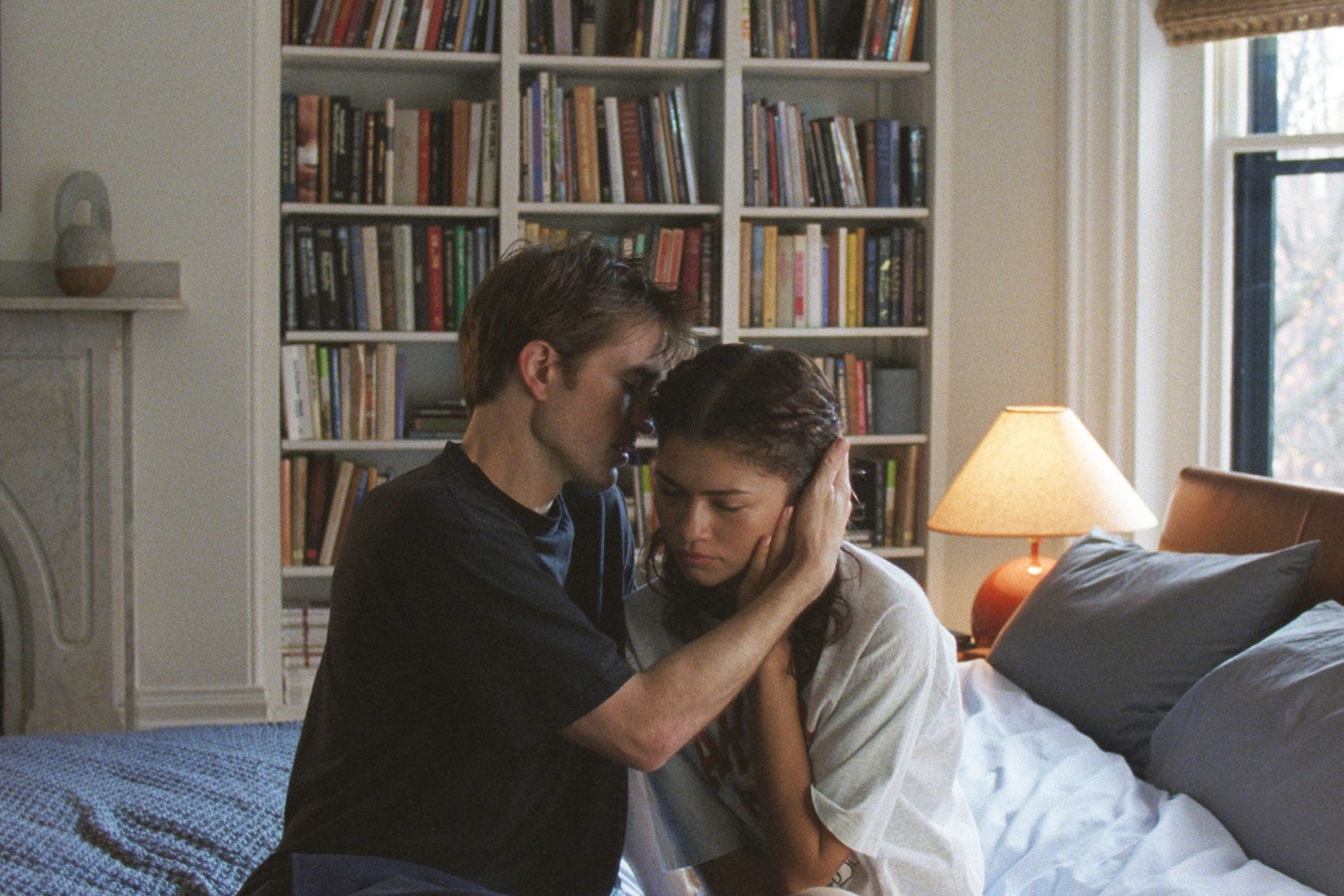
Charlie (Robert Pattinson) sits at the kitchen table in his stylish Boston apartment, workshopping his wedding toast with the help of his best man, Mike (Mamoudou Athie). As Charlie describes his meet-cute in a coffee shop with Emma (Zendaya), a flashback leaves the viewer questioning if it was really all that cute: Upon spotting Emma reading a novel, Charlie anxiously approaches her and pretends to have read the same book, a ruse he tries and fails to maintain throughout their first date. That coffee-shop scene, filmed in jittery jump cuts over an unsettling, woodwind-heavy score by Daniel Pemberton, leaves us with the sense that there is something off about this attractive young couple—though that off-ness initially appears to originate more with the insecure Charlie than with the seemingly sunny and self-assured Emma.
But as the days tick down before they tie the knot, a surprise revelation from Emma opens a gulf between the cozily upper-middle-class pair. (He’s a museum curator, and she’s an editor at a posh-looking publishing house.) At a private tasting dinner to confirm the reception’s menu, Mike’s wife, Rachel (Alana Haim), who is also Emma’s maid of honor, proposes a wine-fueled party game: They should go around the table and confess the worst thing they’ve ever done, so that Charlie and Emma enter the state of matrimony with a clear-eyed sense of their partner’s faults. Mike and Rachel are already familiar with each other’s low points: His is a moment of humiliating cowardice with an ex-girlfriend, hers a teenage act of cruelty toward a mentally disabled boy. Charlie, like the neurotic waffler he will soon prove himself to be, struggles to come up with an answer, finally settling on a high school incident he vaguely describes as “cyberbullying.”
Then Emma brings the evening screeching to a halt by mentioning a phase during her own high school years when she contemplated, but stopped short of, committing a horrific act of violence. The publicity campaign for The Drama has played coy about this “twist,” which in reality is hardly a twist at all—rather, it’s the story’s foundational premise, from which the rest of the action proceeds. Given that this reveal occurs only 20 minutes or so in—and that meaningful discussion of the movie to follow is impossible without taking the nature of the bride’s disclosure into account—I’ll take a page from the provocateur playbook of writer-director Kristoffer Borgli (Dream Scenario) and defy the haters by spoiling Emma’s secret, so stop reading here if you want to walk into The Drama as innocent of its subject matter as A24 wants you to be.
As a troubled teen seduced by the online glamorization of gun violence, Emma once fantasized about committing a school shooting. A series of flashbacks (in which Jordyn Curet plays the teenage Emma) reveals that she went so far as to bring her father’s shotgun with her to school before abandoning the plan, sinking the firearm into a lake, and throwing herself into anti-gun-violence activism.
Is this a destabilizing fact to learn about one’s adorable and adoring fiancée only days before vowing to have and to hold her, till death do you part? Most certainly. Does Charlie, or anyone else in the movie, respond to it the way any real human, rather than a handy plot contrivance, would? Not really. Instead of going home from that awful pre-wedding dinner (which concludes on the first of several instances of projectile vomiting), having a clarifying heart-to-heart about Emma’s past, and pledging to go into couples therapy as soon as the ceremony is over—or possibly before it starts—Emma and Charlie decide to power through their last premarital week pretending that everything is fine. Posing for a chipper wedding photographer (Zoë Winters, who also played a key role in the similarly queasy rom-com Materialists), they display such fake smiles and stiff body language that the photographer has to all but physically move them into poses that suggest real intimacy or affection.
Zendaya’s Emma remains a manic pixie school shooter—and if that phrase strikes you as glibly offensive, wait till you see the movie.
Charlie and Emma’s home life, too, curdles. Their formerly steamy sex life fizzles as Charlie finds himself unable to perform, and little things like a coffee mug printed with the flippant slogan “Coffee or I’ll Shoot” provoke savage fights that threaten the impending nuptials. Both of them also start acting out at their jobs, Emma by sabotaging a professional collaboration with Rachel (who remains openly horrified by her friend’s dinner-table confession), and Charlie by making a bizarre confession of his own to a museum colleague (Hailey Benton Gates). By the time their big day rolls around, both the bride and the groom—but especially the groom—are in a state of profound paranoia and self-doubt that augurs ill for both their marriage and their mental health.
Like Borgli’s previous film, the Nic Cage–starring psychological thriller Dream Scenario, The Drama falls victim to a syndrome that’s sadly common to the kind of high-concept feel-bad movies (Eddington, If I Had Legs I’d Kick You) that have become one of A24’s specialties: The script’s excitement about firing off inflammatory big ideas far outstrips its interest in exploring them. There’s something not just undercooked but insulting about how little attention The Drama pays to the inner life of Emma, ostensibly the movie’s co-lead and the character whose adolescent breakdown serves as the plot’s convenient catalyst. What were her motivations for drunkenly revealing that long-hidden time in her past, not to mention her motivations for contemplating a mass shooting in the first place? Those hurried, mostly dialogue-free flashbacks seem to suggest that teen Emma’s deep feeling of alienation had to do with her status as a mixed-race student at a fancy private school in the South. But we get little sense of how the present-day Emma has come to understand that dark period in the years since. Charlie’s mystification at how his warm, loving, levelheaded betrothed could possibly harbor such a secret is a proxy for the audience’s own confusion. Despite an appealing performance from the impossible-to-dislike Zendaya, Emma remains a story-advancing cipher, a manic pixie school shooter—and if that phrase strikes you as glibly offensive, wait till you see the movie.
For the purposes of the falling-domino plotline, culminating in a “How bad can it get?” wedding sequence, Emma’s past infraction could have taken the form of any number of other mistakes, since the movie’s main intent is not to comment on the gun-violence crisis but to mine the social discomfort of Emma’s revelation for comedy. This does occasion some uneasy laughs, mostly thanks to Pattinson’s self-lacerating performance as the well-intentioned but spineless Charlie. Pattinson has long sought out roles that allow him to heap abjection on his own handsome head, and this part provides ample opportunity to do just that. Even if his character as written makes little more sense than Zendaya’s, Pattinson at least gets lots of solo screen time in which to put poor Charlie through his twitchy, masochistic paces.
The Norwegian filmmaker Borgli, like the English expat Charlie, is a foreigner looking at American gun culture from the outside in—a perfectly valid place from which to begin an inquiry into the school-shooting epidemic, were it not for the rigid incuriosity displayed by both filmmaker and protagonist. What interests Borgli, it seems, are not the phenomena of gun violence and online radicalization in themselves, but the social awkwardness occasioned by talking about them. The Drama’s title could be seen as a joke about the film’s own tonal instability, its existence in a gray zone between genres where satire, rom-com, and cringe comedy overlap. This uncertainty about what kind of movie we’re watching is meant to unnerve and destabilize the audience, a laudable artistic goal as long as the creator taking this edgy stance has anything to say.
Borgli’s Dream Scenario, while intriguingly bizarre, collapsed into a hollow critique of “cancel culture” in its final act. (The recent resurfacing of an unintentionally self-incriminating personal essay by the director, about a past relationship with a high school girl 10 years his junior, suggests that he may have skin in the “What’s the worst thing you’ve ever done?” game.) As for The Drama, it runs out of big ideas—and, seemingly, compassion for its characters—before the audience has had a chance to develop our own rooting interest in, well, the drama. Do we want Emma and Charlie to work things out, or are we meant to envision their doomed future with horror? The filmmaker’s choice to hang The Drama’s narrative on a plot point as fraught as a school shooting constitutes a superficial party game not that different from the one proposed by Haim’s Rachel. What if we all told each other the worst thing we’ve ever done, and one of those things was a movie?