Jade Carter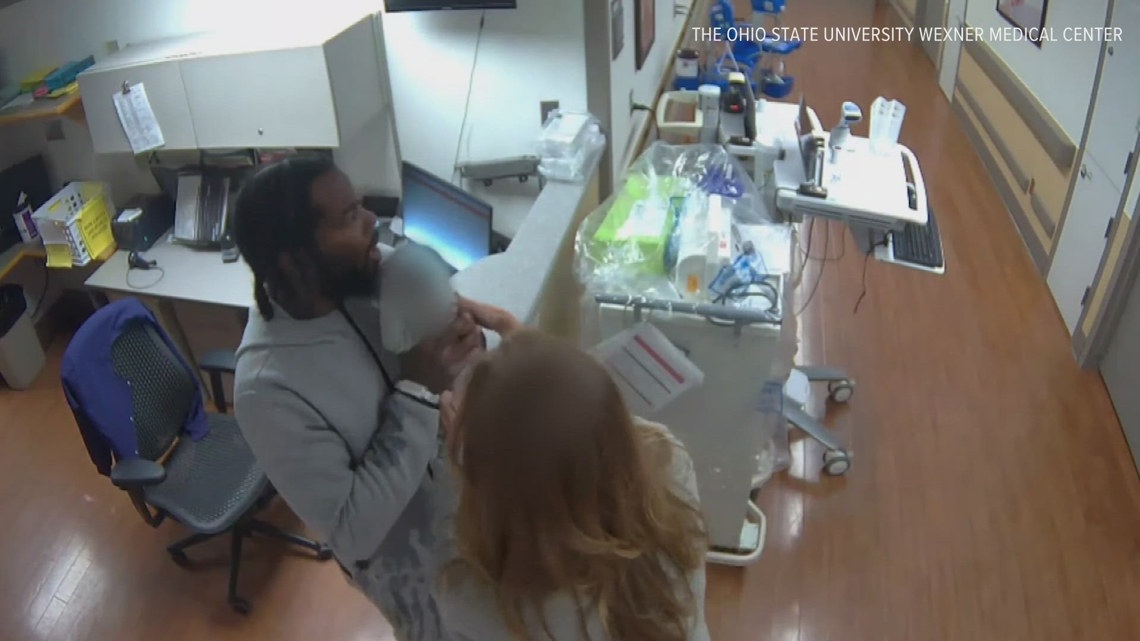
An Ohio State nurse is speaking out for the first time after a reported violent workplace attack last November.
COLUMBUS, Ohio — An Ohio State nurse who was reportedly attacked on the job last fall is speaking publicly for the first time, saying she does not believe conditions have improved — even as the hospital points to progress on workplace safety.
“I thought his plan was to kill me. He was that elevated. He was that escalated. He was that angry,” said Sam McLeod, who has worked as a postpartum nurse at The Ohio State University Wexner Medical Center since 2017. “Scared for my life does not even begin to explain the things that had gone through my head.”
The incident happened on Nov. 6, 2025, when McLeod says she was finishing her shift in the postpartum unit. She walked into what she described as “a full-blown fist fight” between the mother and father of a newborn baby. She says the father was holding his toddler and their newborn.
“He was holding this baby around the chest, not supporting the head, the neck, anything like that. And the baby was being jostled around like a sack of potatoes,” McLeod said.
She said she tried to de-escalate the situation. Instead, she said, the man turned on her — grabbing her at the throat.
“He had placed his hand, grabbed everything and kind of twisted, and placed his knuckles in my neck, and then started dragging me down the hallway,” she said. “The only thing that kept popping through my head was my daughter at home, and am I going to make it home from this shift?”
McLeod said she was dragged about 20 yards, citing an incident report, and strangled with her own lanyard.
“And at that point, I was begging him to let me go,” she said. “He said, ‘Nah, man, you’re coming with me.”
“Scared for my life does not even begin to explain the things that had gone through my head,” she added.
McLeod said help did not come right away.
“I mean, he could have killed me multiple times in that 10-minute time span, and there was no help,” she said.
A spokesperson with Wexner Medical Center said the security response was three minutes.
McLeod said she was eventually able to break free from his fingers, but faced a difficult decision in the moments when she was being dragged.
“The hardest part of that was I had to decide whether I risked that baby’s life to protect my own,” she said. “And I couldn’t do anything to jeopardize the life of that baby.”
Months later, McLeod said she is still recovering and has not returned to work.
“My life is forever altered,” she said. “I am so fearful of people because it was such a random act of violence.”
McLeod said she is receiving about 60% of her pay through workers’ compensation and is struggling to get the hospital to cover treatment for post-traumatic stress disorder.
“I feel like I’m being penalized for doing something good and protecting this child,” she said. “Taking care of people and little babies and tiny humans and new moms is such a passion for me, and that has been stolen right now.”
The hospital’s spokesperson said the nurse was offered support through Ohio State’s Employee Assistance Program and the Stress Trauma and Resilience program.
“We adhere to all procedures and requirements established by the Ohio Bureau of Workers’ Compensation when reviewing claims and treatment requests,” the spokesperson said.
McLeod said she decided to speak out now because she believes workplace violence is more common than people realize — and because she wants to help others.
“The rally they had last fall for me could have very easily been a vigil,” she said. “This is happening every day, not just at OSU. I want to make sure other nurses and staff are protected.”
Her comments come as the Ohio State Wexner Medical Center on Thursday released the Workplace Safety Update for July to December 2025, a biannual report highlighting improvements.
Hospital leaders say the rate of clinical support calls and incidents has declined by 25% since 2021, even as the system has grown. The report also points to expanded de-escalation training, increased use of specialized response teams and more security screening.
But the report’s own data shows some of the most serious situations — including assaultive incidents and cases requiring staff to restrain aggressive patients — have increased in recent years.
“There are times where it doesn’t matter how much de-escalation training we are given,” McLeod said, looking over the report. “There’s going to be cases like mine where it doesn’t matter.”
She said the focus on training shifts responsibility onto staff.
“The whole de-escalation thing is just a cop out for them,” she said. “They want to put it back on us.”
Hospital leaders say the progress reflects broader engagement across staff.
“These results show what is possible when we all share the responsibility of workplace safety and use the tools available,” said Elizabeth Seely, chief administrative officer of the hospital division and co-chair of the Workplace Safety Steering Committee, in a statement posted online. “The progress we’ve made to date is thanks to our team members’ engagement across the medical center, and we’ll continue to seek their feedback to help drive ongoing improvements.”
McLeod said more concrete changes are needed, including mandatory response times from security and closer coordination with university police.
“I am vehemently assured that they are not doing everything that they could to protect us,” she said.
Thirty-one‑year‑old Asiakare Minor of Reynoldsburg, who was charged with strangulation and unlawful restraint in connection with the assault, has pleaded not guilty. His next court appearance is scheduled for April 27.
McLeod said she hopes speaking out now will lead to change and that she can go back to doing what she loves soon, alongside coworkers she cherishes, who she says deserve better.
“I am fighting for them, and I want them to be protected like I wasn’t,” she said.