The S&P 500(SNPINDEX: ^GSPC) has now declined in four consecutive weeks, leaving the index nearly 6% below its record high. Apart from energy stocks, it’s been a challenging year for equities across the board, though losses have been more pronounced in certain sectors.
The information technology sector is 12% below its high because investors are concerned that artificial intelligence (AI) spending is unsustainable.
The consumer discretionary sector is 12% below its high due to concerns about tariffs and rising oil prices, which some economists argue have raised the odds of a recession.
The financial sector is 12% below its high because the private credit market is showing signs of stress. In Q4 2025, delinquency rates on U.S. loans reached their highest level since 2017.
The materials sector is 11% below its high because rising oil prices and falling metal prices threaten to raise costs and slow revenue growth for manufacturers and miners.
The communications services sector is 9% below its high due to its heavy concentration in advertising stocks, which tend to perform poorly during periods of economic uncertainty.
Collectively, those concerns have created a great deal of volatility in the stock market. The CBOE Volatility Index(VOLATILITYINDICES: ^VIX) — often referred to as the stock market’s fear gauge — closed at 29.5 in early March. The index has not closed above 29 since President Trump announced sweeping tariffs last April.
Will AI create the world’s first trillionaire? Our team just released a report on the one little-known company, called an “Indispensable Monopoly” providing the critical technology Nvidia and Intel both need. Continue »
However, VIX readings above 29 have historically correlated with substantial upside in the stock market. Here’s what investors should know.
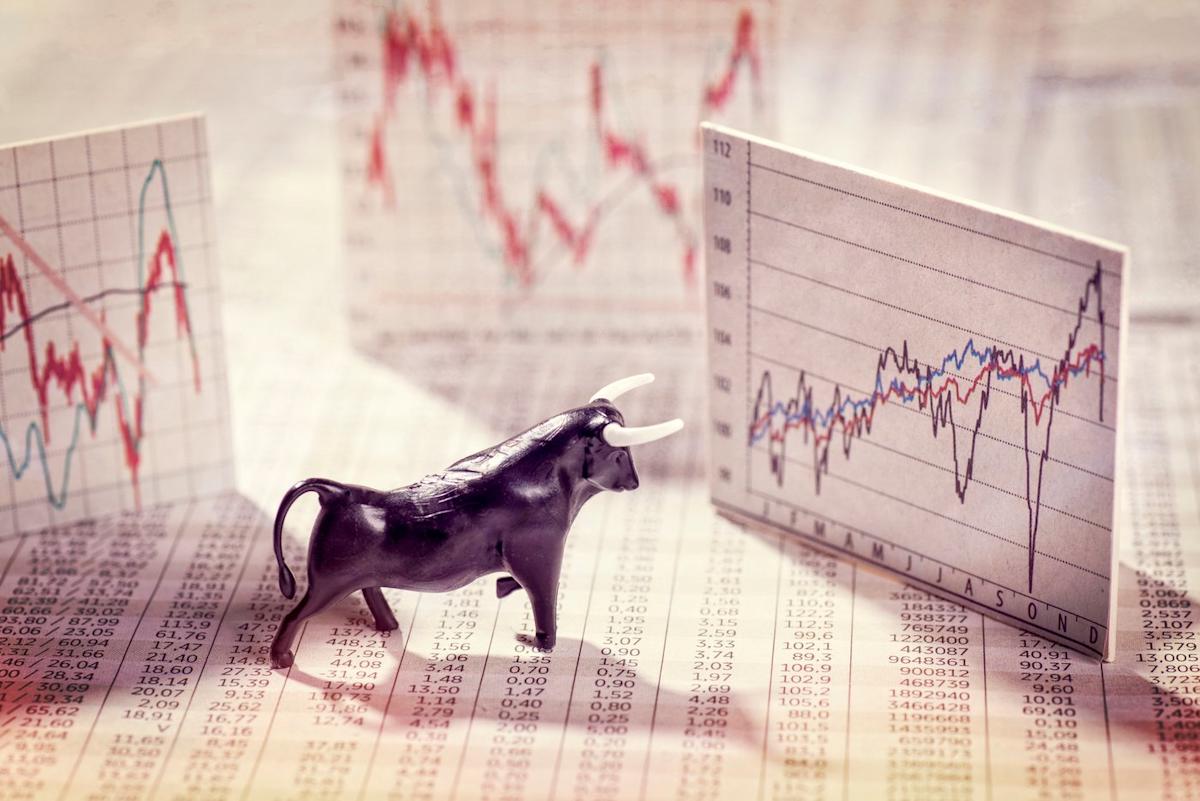
Image source: Getty Images.
The CBOE Volatility Index (VIX) measures the expected volatility of the S&P 500, with higher readings implying larger price swings. Its value at any given time depends on how much investors are willing to pay for S&P 500 options contracts. A VIX of 29 means investors expect the S&P 500 to move up or down by 29% over the next year.
The VIX closed at 29.5 on March 6, marking the 265th time the index closed above 29 over the last 15 years. That hints at substantial forward returns in the stock market. In the last 15 years, the S&P 500 has recorded an average 12-month gain of 24% following a VIX reading above 29.
What does that mean for investors? When the VIX closed at 29.5 on March 6, the S&P 500 closed at 6,740. Advancing 24% from that level would bring the stock market benchmark to 8,358 by early March 2027, which implies 27% upside from its current level of 6,582.
Wall Street expects a similar move in the S&P 500 during the next year. The bottom-up consensus forecast — meaning the value implied by aggregating the median target price on every stock in the index — says the S&P 500 will reach 8,338 by March 2027, according to FactSet Research. That implies nearly 27% upside from its current level.
However, that bottom-up consensus is based on expectations that S&P 500 companies will collectively report earnings growth of 16.3% in 2026, an acceleration from 13.8% in 2025. Wall Street analysts may reduce their forward earnings estimates if the U.S.-Iran war keeps oil prices elevated.
Last week, Moody’s chief economist Mark Zandi warned that conflict in the Middle East could even tip the U.S. economy into a recession. “If oil prices remain elevated for much longer (weeks, not months), a recession would be difficult to avoid.” In that scenario, history says the S&P 500 would fall sharply over the next year.
Here’s the big picture: Investors tend to overreact to bad news, so the stock market often performs well after periods of elevated volatility. However, past performance is not a guarantee of future results. Rising oil prices could cause corporate earnings to grow more slowly than Wall Street anticipates, in which case the upside implied by a VIX reading above 29 may not materialized.
Either way, investors should stick with what works best: Buy and hold high-quality stocks no matter what happens in the near term.
Before you buy stock in S&P 500 Index, consider this:
The Motley Fool Stock Advisor analyst team just identified what they believe are the 10 best stocks for investors to buy now… and S&P 500 Index wasn’t one of them. The 10 stocks that made the cut could produce monster returns in the coming years.
Consider when Netflix made this list on December 17, 2004… if you invested $1,000 at the time of our recommendation, you’d have $495,179!* Or when Nvidia made this list on April 15, 2005… if you invested $1,000 at the time of our recommendation, you’d have $1,058,743!*
Now, it’s worth noting Stock Advisor’s total average return is 898% — a market-crushing outperformance compared to 183% for the S&P 500. Don’t miss the latest top 10 list, available with Stock Advisor, and join an investing community built by individual investors for individual investors.
Trevor Jennewine has no position in any of the stocks mentioned. The Motley Fool has positions in and recommends FactSet Research Systems and Moody’s. The Motley Fool has a disclosure policy.
Patricio ‘Pitbull’ sets sights on former champ after Aaron Pico fight at UFC 327
Relatively new Ultimate Fighting Championship fighter Patricio Freire is looking to pay someone back for their harsh words about his previous organization. Freire (37-8) spoke to Sherdog this week, who…
How Geoff Alexander quietly turned Illinois into March’s most unique team
Zvonimir Ivisic How Geoff Alexander quietly turned Illinois into March’s most unique team originally appeared on The Sporting News. Add The Sporting News as a Preferred Source by clicking here.…

 Lily Maxwell